
Listening guide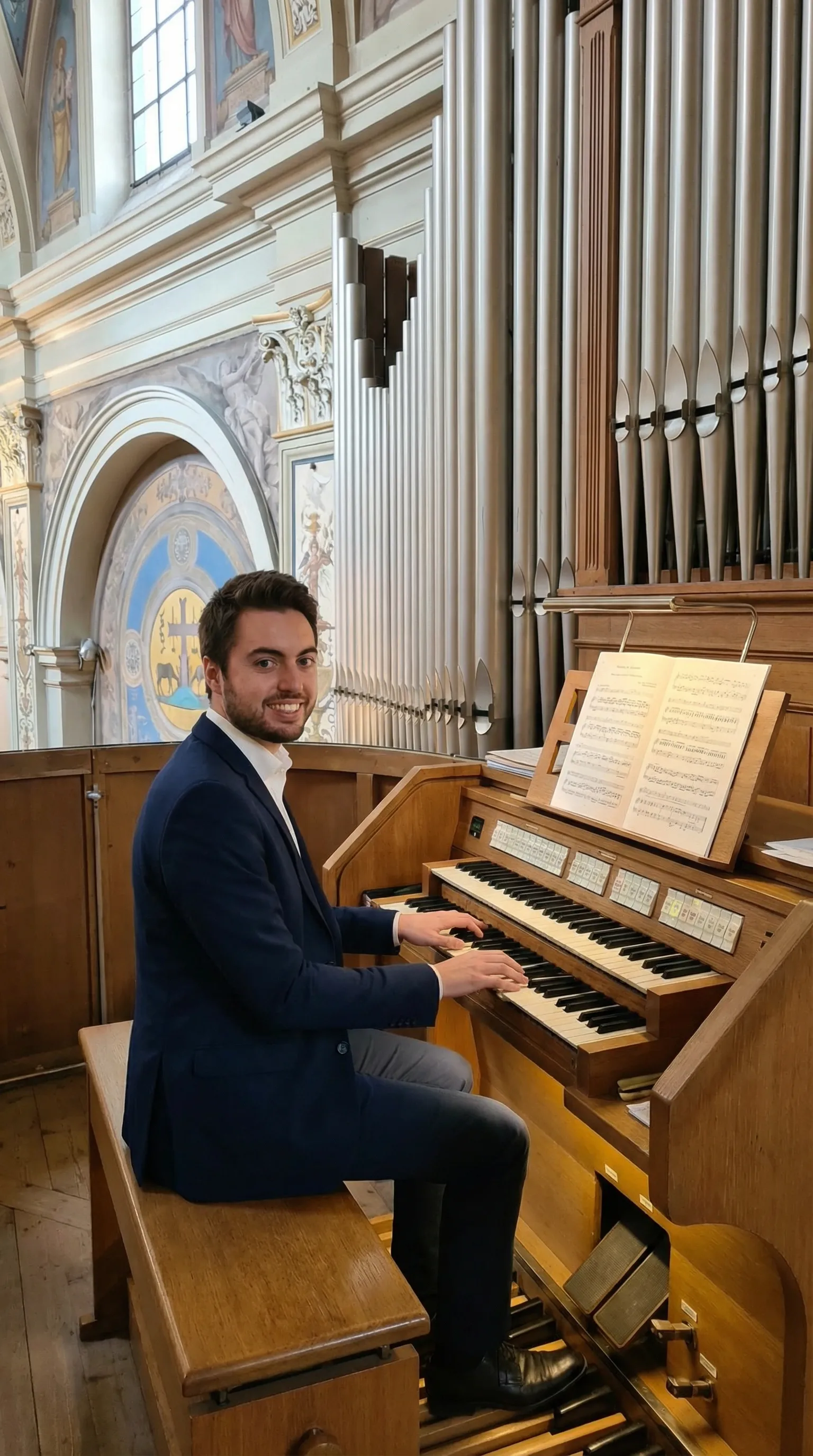
Santa Maria degli Angeli: the full story
Organ concert in Milan
- 21:00 · doors 20:45
- Santa Maria degli Angeli (Sant'Angelo), Piazza Sant'Angelo 2, 20121 Milano
A sample of the repertoire
The programme for this date has not been published. The organist introduces each piece before he plays it.
- Introduction & Allegro (from Concerto Gregoriano)P.A. YonPietro Yon was born in Piedmont and worked in New York, where he became organist of St. Patrick's Cathedral. His Concerto Gregoriano, published in 1920, takes its themes from Gregorian chant and sets them in a showy, romantic style. It opens the evening on the full organ, so you hear at once what 4,600 pipes can do.
- Cornfield Chase (from Interstellar)H. Zimmer, arr. A. LapwoodThe music of the cornfield chase in Interstellar. Hans Zimmer recorded the score of the film with a church organ, at the Temple Church in London, so the organ is part of its original sound.
- Ave Maria (Méditation)J.S. Bach / C. Gounod, arr. M. De VitaGounod wrote this melody in 1853 over Bach's first prelude from The Well-Tempered Clavier, which dates from 1722. The organ plays both together.
- Bossa Nova (from 3 Jazz-Präludien)J. MichelA jazz piece with a syncopated rhythm, played on a church organ. The audience usually smiles.
- Davy Jones (from Pirates of the Caribbean: Dead Man's Chest)H. Zimmer, arr. A. LapwoodIn the film the villain, Davy Jones, plays an organ on his ship. His theme starts like a music box, then the organ comes in. When the lowest pedal notes arrive, you can feel them in the floor.
- Chevaliers de Sangreal (from The Da Vinci Code)H. Zimmer, arr. A. LapwoodThe main theme of The Da Vinci Code, a film about the search for the Holy Grail. In the film it is played by strings, a choir and synthesizers; here the organ plays all of it. It starts very quietly and grows to a fortissimo that you feel in your seat.
- Test Drive (from How to Train Your Dragon)J. Powell, arr. A. LapwoodThe flying theme from How to Train Your Dragon, built on Celtic-style melodies that climb higher and higher.
- Main Titles (from Cinema Paradiso)E. Morricone, arr. M. De VitaThe main theme of Cinema Paradiso, Ennio Morricone's score for a film set in a small town in Sicily.
- Love Theme (from Cinema Paradiso)A. Morricone, arr. M. De VitaWritten by Ennio Morricone's son Andrea. The organist uses the expression pedal to make the sound of the pipes swell and fade like a voice. It is the music of the film's famous kissing scene.
- Main Titles (from Once Upon a Time in the West)E. Morricone, arr. M. De VitaThe main theme of the Spaghetti Western Once Upon a Time in the West, by Ennio Morricone. In the film the soprano Edda Dell'Orso sings the melody without words; the organ's reed stops imitate her voice.
- Waltz No. 2 (from Suite for Variety Orchestra)D. Shostakovich, arr. M. De VitaA grand, slightly ironic waltz, known from Kubrick's film Eyes Wide Shut. It asks a lot of the organist's coordination.
- No Time for Caution (from Interstellar)H. Zimmer, arr. A. LapwoodThe docking scene from Interstellar, where the spacecraft docks with a spinning station. The organist plays fast, with both hands moving between the keyboards and both feet on the pedals.
- Finale (from Concerto Gregoriano)P.A. YonBack to the work that opened the evening: the last movement of Yon's Concerto Gregoriano, with every stop drawn. The last chord stays in the vault for several seconds after the organist lifts his hands. Then the applause.
The organist
Marco De Vita
Assistant organist of Milan Cathedral
“The pipe organ is the original synthesizer. It can sound as soft as a flute or as loud as a whole orchestra.”
Top marks in Organ at the G. Verdi Conservatory of Milan and a Master's at the Pontifical Ambrosian Institute of Sacred Music. He also arranges film scores for the organ.
The church: Santa Maria degli Angeli
A Franciscan church near Brera, consecrated in 1555, with nineteen chapels and an organ of about 4,600 pipes.
While you wait, look around
Numbered as on the plan of the church on its own page.
- 1The organ consoleBehind the high altar, in the choir: four keyboards of 61 notes, a pedalboard of 32 and 76 stops. The console is a piece of furniture of its own, joined to the pipes electrically.
- 24,600 pipes in five casesThe Tamburini organ, Opus 372, built in 1957 and restored in 2003: four cases, two in each arm of the transept, and a fifth on the back wall of the apse, so the sound reaches you from every side.
- 3The high altarBaroque, in polychrome marble and pietre dure, carved in 1708 by Giovanni Battista Dominioni.
- 4Angels playing musicCamillo Procaccini frescoed the presbytery in the 1610s: the Assumption of Mary in the vault, surrounded by angels playing lutes, harps, strings and trumpets.
- 5The great archAbove the arch between the nave and the transept, Legnanino's Coronation of Mary.
- 6Nineteen chapelsEight on each side of the nave and three on the transept, each kept by an old Milanese family or guild: works by Antonio Campi, whose shadows came before Caravaggio's, Morazzone, Camillo Procaccini, the Fiammenghini and Simone Peterzano, Caravaggio's first master.
- 7The façade and the doorsTwo orders of columns, finished in 1630, with their statues of Franciscan saints; above the main door, St Michael defeating Lucifer.
- 8The fountain of St FrancisIn the square, the saint among six bronze doves, with lines of his Canticle of the Creatures on the rim: Giannino Castiglioni's fountain, inaugurated in 1927.
Santa Maria degli Angeli in a minute
- 1436A larger church, named after Santa Maria degli Angeli in Assisi, and later a convent for 200 friars.
- 1551Damaged by fire in 1527, it is pulled down to make way for the new Spanish walls.
- 1555The church is consecrated on 23 May.
- 1810Napoleon's government closes the convent: it becomes a prison and a military court.
- 1957Tamburini builds the organ, Opus 372.